Wednesday, September 19, 2012

Amsterdam

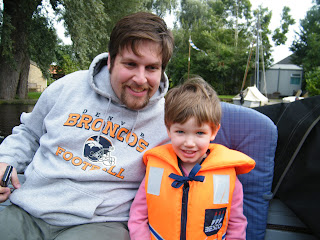
Autumn has come to the Netherlands.  I was startled to see the leaves start falling last week already, and I  had to remind myself that the NL is several degrees farther north than the PNW.  The temperature has dropped to about 60 degrees farenheit, and all the locals have dug out their coats and swapped their frothy scarves for scarves that might actually keep their necks warm.  As Seth puts it, it's good football weather. 
 
I was going to stun all my readers with beautiful pictures of our Amsterdam journey last weekend, but it turns out that a bus window is not the best way to see a city.  We signed up for a bus and boat tour because it promised to show us the most of the city.  I don't think their ideas of important matched up so well with our ideas of important.  For instance, I got the shock of my life while we were driving through a red light district (apparently there are three) when I saw a young woman posing in a window.  At first I thought she was a manikin for a lingerie shop.  Then we made eye contact.  That will bring the reality of legalized prostitution home in a hurry.   And we really didn't need to know where the most expensive houses in Amsterdam are.  The tours are mostly designed to show you where the sights are.  They don't really give you a chance to see the sights. 
 
 
We spent two hours on the bus, took a break for lunch, and then spent an hour on the boat.  By that point, the Boo had had enough, so we stopped at a candy shop and called it a day.  So my advice if you want to tour a foreign city would be figure out where you want to go, figure out how to use the public transportation, and then go where you want to go.  You'll save money, and you'll go where you want to go.  That's what Seth plans to do once we've gone home and he doesn't have to worry about the attention span of a four-year-old.  Am I jealous?  Yeah, a little. 
 
Here are some of the pictures that I did get:
 
This is Amsterdam Centraal Station where we arrivd a little after 9 o'clock in the morning to begin our tour.  We were kind of confused by the clocks at first until we realized that the one on the left tells wind direction, which given the number of boats moving in and out of the square in front of the station makes perfect sense. 


The Shipping House, a.k.a. the House of a Thousand Windows, once guardian to Amsterdam's Old Harbor. 


Sculptures of Renaissance and Classical gentlemen.  I found it ironic that they are on the outside of the Museum of Modern Art. 

Point of interest: the buildings alongside the canals lean when air gets at their support posts.   

Old and picturesque defense tower.


The shortest canal in all of Amsterdam.  I love taking pictures of water.

This is how you get Rembrandt to take your picture.  The windmill in back is called "Rembrandt's Windmill" because he often went there for inspirtation. 
 

The Rijks Museum, national art museum of the Netherlands.

The Van Gogh Museum, which our tour guide called the "Van Gog" museum.  I thought Van Gogh was the Dutch pronunciation.  Maybe not.  This is one of those places that Seth will be coming back to.  I told him to get me a poster.

The N.E.M.O. or science and technology museum. 

The Tower at the Sharp Curve in the Wall which has somehow become The Weeping Tower over time.  The names in Dutch are very similar.  One devolved into the other.  Still, the name "Weeping Tower" sounds like it would have a story behind it, and it doesn't. 

The Royal Palace

Boogaloo tackles an enormous shoarma hamburger, and yes, she did finish the whole thing. 

Monday, September 17, 2012

Man against the Sea

On our way home from Friesland, we stopped at the one place that all our Dutch relatives said that we had to see: the Afsluitdijk (O-sloo-dike).  The Afsluitdijk is a large earthenwork dam that stretches from Friesland to North Holland across the Zuiderzee, the part of the North Sea that stretches into the Netherlands. 


Boogaloo and I stand on the walkway at the monument in the center. 
Behind us is the IJsselmeer and the flags of Friesland and North
Holland. 
It was plain to the Dutch even back in the early 1700s that some sort of dam was needed in the area of the Zuiderzee. The farmland was getting salty, and the tides were too much for the minor dikeworks already in place.  However, 20 miles of of earth and sluice gates takes a lot of money, and pumping out an ocean (essentially) takes modern technology like steam power.  The Afsluitdijk construction project officially began in 1920 after a huge flood proved even to Parliamentarians that measures had to be taken. 
 
The Afsluitdijk is constructed on a 90 m base of stones a lot like the ones you see in the picture below.  These stones were loaded into boats and carried to the site of the dike and then placed by hand over the course of the dike. 
 
Over the stones, the engineers put a special kind of clay called boulder clay and then rocks, sand, and earth.  The end result looks like this. 
 
 
I though the Afsliutdijk would be more technological with metal and hinges and lockes.  Apparently , I was thinking of the Delta Works (wikipedia entry) around Amsterdam which were built in the 1950s to regulate flooding and shipping. 
 
The Afsluitdijk is no less impressive in its own way.  It has four gates that systematically pump water out of the IJsselmeer into the North Sea at low tide every day. 
 
 
It's an uncanny feeling to stand on the top of the dike facing north and see the that water to your left is distinctly higher than the water to your right. It's also very hard to capture with a camera.  We made several valiant efforts, but this is the best we could do. 
 
 
 The IJsselmeer, which was once ocean, is now fresh water, a testament to Dutch dam building technique and the amount of rain the Netherlands gets each year.  It's also a bit mind boggling.  This is definitely man-made environmental change, but it seems to have worked out for all concerned.  Boo was fascinated by the water, and we had to watch her pretty constantly to keep her out of the foam.  If you look at the jetty she's running on, you can see the foundation stones of the dike. 

 
If you get the Afsluitdijk, there is a monument to the hard work and ingenuity of the Dutch people in the middle of it.  You can climb to the top of the monument and look out at the Waddenzee and the IJsselmeer.  Then you can stop at the gift shop on the first floor on your way to the coffee shop in the basement.  Really, at this point on the dike, coffee is probably a good idea.  It's cold out there. 
Add caption

Seth on top of a minor dike on the Waddenzee side of the Afslluitdijk. 

Sources beyond my observations:
Deltaworken Online.  2004.  The Stitchting Deltaworken Online. 
www.deltaworken.com

Aflsuitdijk.  Wikipedia. Accessed 9/17/2012. 
http://en.wikipedia.org/wiki/Afsluitdijk


Monday, September 10, 2012

How we spend our time

We are not finding Eindhoven as family-friendly as Almelo, at least not the area we are living in.  If we were inclined to shop, then there would be plenty to do.  Seth hazards the hypothesis that since buying a nice car or building a nice house is not so much a priority in the Netherlands, more money goes into discretionary spending like clothing and gadgetry, and boy, you can tell.  There are so many clothing stores, electronics stores, shoe stores (especially shoe stores), and little tasty tidbit stores that I've started cataloguing the Starbucks effect.  Didn't I just see that store a block ago? 
Boo's first happy experience with a carousel.  There was a time
when she would not go anywhere near a carousel horse, but
now it's one of her favourite things. 
We do indulge in a little bit of shopping, though not that kind.  There is an open air market in the square across the street every Tuesday, so we wander through that to buy our produce, some fish, and some wonderful pastries.  When the market is open, so is the carousel which thrills Boogaloo to no end.  We also hit the grocery store two or three times a week (at least).  We've noticed that the Dutch don't really believe in family-sized packages.  For instance, milk doesn't come in larger than half gallon containers.  By the same token, produce seems to spoil rapidly, so it's no good stocking up.  Consequently, we wander down the street to the Jan Linders on an almost daily basis.    
Boogaloo observes the fish in the canal that runs through central
Eindhoven. 
Walking is probably what we do the most of.  There is a lovely greenway along the Dommel River that ends in a children's park and wildlife preserve just outside the high school.  I would go there every day, but it's about an hour's walk which is a long time for little feet (and little bladders, and since they don't believe in public potties for Dutch parks, we don't go there very often. The Dutch have come up with an ingenious system for managing the call of nature.  You can go into any public place you want to use the "toiletten," but you have to pay 50 cents.  Some of the gas stations let you use the 50 cents to buy something in the convenience store.  The only problem with the green way is that it's surrounded by apartments and schools, so ducking in and borrowing a potty isn't a possibility.) 
The greenway by the Dommel River. 
"What is it?" Boogaloo said, and I had no answer.
 It sits in the middle of the canal, and evidently it moves, but I don't know what it is. 
The Van Abbe Art Museum, which we have not been in, but
which Boogaloo loves for the horses. 
More breathtaking greenway by the Dommel River.  An elderly gentleman on a bicycle who spoke no English told me that this kind of park is called a "Park Frank" or German-style park.  Of course, I also thought he told me that there was no slide at the end, and there was, so take my understanding with a grain of salt. 
The greenway is dotted with weeping willows, possibly my favorite tree on earth.  If it were just more convenient for small children, we would spend all day every day there. 

We've just discovered another little park on the other side of the shopping center, but even that is half an hour away.  Sometimes I wish we could just borrow the grass in the churchyard across the street for an hour or so, but they have it all fenced off.  I get the feeling that a lot of university students (Eindhoven is a university town) have borrowed the grass before. 
When we aren't walking, we're mostly at home in our little apartment. Boogaloo spends a little time on the computer each day improving her vocabulary. She just mastered the use of the mouse which means she can direct her own course. She likes that. She's also discovered that she can climb up on the window sill, so now she uses it for everything from a bed for her animals to an imaginary mountain to climb (we had to put a stop to the mountain climbing. It was making me nervous.). We hunted down a toy store at the top of one of the malls across the street and bought her some sidewalk chalk and bubbles which keep her entertained on the patio.

Boo stands proudly among her pictures on the patio.  Our patio is
now so full up of pictures that we're waiting for a good rain to
erase it all so Boo can draw again. 
Boogaloo masters the mouse on Starfall.com.  What you see in the cups in a Dutch food called "vla," which
we suspect is American pudding in cartons.  It's very tasty and comes
in an amazing array of flavors, and like most of the food out here, it's
pretty cheap. 
Once Seth comes home, and he often comes home early, then we hop in the car and seek out some of the local sights. We found an open-air historical museum last week, but it was closing as we found it, so I have no pictures as of the moment. We also found historical caves outside of a neighboring city, but we didn't find the touring schedule until they were closed, so we hope to take that in before we leave too. In spite of our bad timing, we always find something worth seeing. In place with this much history, it would be impossible to go a day without finding something. 
The artwork over the doorway of the Church of St. Joris (St. George). 
 

Thursday, September 6, 2012

Investigating our roots

After leaving Almelo, we took a weekend detour through Friesland before going back to work on Monday. Yes, for those of my readers who know the word friesian, I do mean that Friesland. For those who don't, Friesland is one of the northern most provinces of the Netherlands.
It has a unique personality because it's the one Dutch province that the Romans didn't conquer when Julius Caesar came up the Rhine in whatever year B.C.E.   Friesland is also the province that has been most reclaimed from the sea. Canals are more popular than roads, boats and bikes than cars, and every house and field backs up to a waterway.
 
Pulling up to Kees and Rie's backyard.  This once was the
location of a WWII farmhouse.  Then it became a thriving boat
 building business.  There is a road out front, but the canal out back is bigger.
 
The Friesian people are proud of their differences and very proud to be Friesian.  The average Dutchman is inclined to roll his eyes if you mention Friesland to him because they've all had a taste of Friesian pride, and they're none of them inclined to think it warranted.  Still, after seeing a glimpse of Friesland, I have to think that the Friesians are uniquely privileged to live where they do and uniquely gifted to have pulled it off. 
 
Those "triangular white things" as seen from far off.
Driving through Friesland is a peculiar feeling because the land is so flat. I didn't realize at first that I wasn't just looking at fields of green grass with cows and sheep peacefully grazing.  There was something wrong with the landscape, and it took me a while to spot it.  "What on earth," I thought "are those white triangular things in the fields?"  Then I saw the bridge in front of us lift up and one of the strange triangular objects glide underneath it, and the reality hit me.  Those were boats, specifically pleasure craft sailing on the canals on a fine summer Saturday.  The canals were that close to the road and cut right down the middle of the fields. 


We spent the weekend with Kees and Rie, Seth's great-uncle and aunt.  Specifically, Rie is Beppe's younger sister.  In their younger days, Kees and Rie operated De Horse Watersports, a homebuilt boat building and rental operation.  Nowadays, they purse their various hobbies (Kees -- the stockmarket and philosophy, Rie -- quilting and gardening), dote on their grandchildren, and show American relatives the special places of their Friesian roots. 
Uncle Kees ("Case") and Aunt Rie ("Ree") catching me in the
act of snapping their picture. 
 
The church in Toppenhuizen.
The afternoon that we got there, Rie took us to see the old churches of Toppenhuizen and Oppenhuizen where generations of Atsmas and Wijnijas are buried (I looked for Roordas or Beibors but in vain.  I did, however, find a lot of names I knew of no relation.  Look for them in a later post.) .  These churches have all the old accoutrements: wooden benches, raised Scripture podiums, liturgical drapings, and Christ candles, but they are in no way out of date.  The fellowship hall in Oppenhuizen has a computer on wheels and was preparing for a gathering with a sister congregation from (Eastern) Germany, and as Rie told us, they have a female minister.  Still, the churches are old and in the process of being restored as historical objects.  The Toppenhuizen church was built in 1695, a time when Dutch Reformed Christianity was not yet a settled business. 
 
Boogaloo finds her favorite animal on the foot of the preaching podium. 
 
The organ in the church at Oppenhuizen.  Seth has a fondness for
large organs. 
Rie was surprised that the CRC churches in the
States no longer use the liturgical drapings or podiums.
 
The next day, Kees and Rie took us out on one of Kees's boats.  Being a boat builder, he has two operational boats and a couple of others lying around. Just behind his house is the harbor that he built on land that he purchased from the government.  The number of boats in it testify to the necessity of water transportation around here. 
A view of the canals heading under the main highway.
The canals themselves are much bigger than I expected.  I was expecting something about ten feet across, something akin to the irrigation canals I had known growing up in the Yakima Valley or the waterways I had seen in Eindhoven.  No, the canals in Friesland are like major rivers.  They support industrial shipping and major transportation.  You'd never know that they are a manmade feature to look at them because they bend and curve just like rivers, and the edges are rough and natural, largely unmarked and seemingly unfortified.


Water in Friesland is an acknowledged part of daily life.  Children learn to operate boats from the age of six or seven, and the water has its own edicate.  At the revolving bridges, boaters have the right of way, and road traffic waits for the boats to pass by.  In some places, the road has died away, but the bridge still stands open on the canal, like an disused railroad crossing or a superwhammadine lawn ornament.


A Friesian youngster operates his or her first solo boat. 

A disused rotating bridge from a road that no longer exists.
 Notice that the bridge is still painted.  Friesians keep their backyards neat. 
Boogaloo gets her Friesian on.  Kees showed her how to toss the
float outand pull it back.  She thought it was great.  On a side note,
we discovered that Boogaloo is the fifth girl to be named after Beppe.
Beppe also has three nieces and a granddaughter named for her.   

What you are looking at, behind my husband, is a dike. 
Behind that, where the cows are, is a polder. 
  
 I spent the first fifteen minutes of the boat ride looking for a glimpse of the famous dikes and polders before I realized that the dikes are that slight swell of land on the edge of the field and the polders are everything in between. As Seth commented, it can really give you a turn to realize that the land on the inside of the dike is about six inches lower than the water on the outside because when you're out here, you realize that the dikes don't enclose the water.  They enclose the land and keep the water out.    
 
The water is beautiful, but after an hour on the canals,
 Boo decided she was ready to be back on land. 


Thursday, August 30, 2012

A day in our life at Almelo

 
The canal by the park. 
How does one spend time in a foreign country?  Well, I suppose it depends on the time allotted one.  This isn't a typical vacation.  We have way too much time and not nearly enough flexibility to play tourist all the time.  Seth works five days out of the week, so Boogaloo and I are on our own most of the day.  I'm not the most adventurous of persons, and the Boo isn't the most patient of walkers, so we don't go far from home or hotel at any given time. 


Boogaloo by the canal that runs through downtown Almelo.  The
ducks have the run of the whole town and go wherever they want.

Our average day looks like this:

8 or 9 am breakfast 
A church in downton Almelo.  It's a real church,
not a tourist destination.  I could tell because
the parking lot was still private. 
It takes a while to the Boo motivated down to the breakfast hall, but Seth has to be at work by 9, so we do our best to get down there as soon as comfortably possible.  European hotels serve (surprise!) continental breakfasts but on a much grander scale than most American hotels.  There are at least seven kinds of breads to choose from, and only one of them is sweet. (This seems to be a trend with European food.)  Meat is presented in bacon, sausage, pancetta, sliced ham, and pastrami forms, plus there are eggs, fruit, real and canned yogurt, and all the usual drinks plus buttermilk.  I didn't know that people actually drank buttermilk. 

9 am Preparation
We head back to the hotel room.  Seth has left for work.  Boogaloo plays with her Escher lizards while I read my Bible, pack the backpack, and stow away any personal belongings.


10 am Clear out so as not to inconvenience housekeeping 
Boogaloo chases the ducks in the gardens outside the Huis van
Almelo. 
The maid comes by at about 10 in this hotel.  Intending to be out of her way,  we bop down to the elevator and betake ourselves out the door right about 9:56.  Each day we set ourselves a task.  Monday's task was to find the grocery store.  Wednesday's task was to find out if the Huis van Almelo  is open for public tours.  It isn't, but it sits in the middle of a very nice public park with deer, ducks, and a pair of black swans (yes, I'm not kidding).  Friday's task is to investigate a candy store, a toy store, and a chocolatier.  You get the picture.


The butterfly bush. 
 
After completing our "job," we always end up at a little park by the canal behind our hotel.  This park is unique in that it has a slide and a sandpit, which keeps the Boo happy and makes it a necessary stop each day.  This park also has a beautiful butterfly bush which is full of, you guessed it, butterflies.  Sometimes they'll flutter just low enough that Boo thinks she can catch them.  She chases them halfway across the park. 
Lunch with Seth in the plaza. 

12 pm  Home for lunch
The maid is finished well before noon, so we head back to the hotel.  By this time, the Boo needs a potty break, and as there are no public toilets in Dutch parks, we find this a good time to go home.  Lunch is peanut butter and nutella sandwiches with whatever fruit we have lying around.  Sometimes it's leftovers from the night before.  Today at lunch, the Boo and I ate cold Greek pork and French fries with our fingers out on the patio.  It was an oddly freeing experience. 

Sometimes Seth comes home for lunch rather than buy it from the cafeteria.  Then we go out and enjoy the plaza scene. 
12:3o to 2:30 pm
I put in a movie for the Boo and get some work done.  Sometimes I blog.  Sometimes I pay bills.  Sometimes I grab a nap. We only have two hours of Internet each day, so we have to be sparing, but the Boo stills gets a half an hour of educational website, and I get my fifteen minutes of facebook. 

2:30 pm
A black swan is supposed to be a rare thing.  Huis van Almelo has
a matched pair in its gardens. 
Sometimes Seth is home by 2:30, and then we go and investigate the results of our morning's explorations.  If he isn't home, I leave a note that tells him where we're going, and we take off on an afternoon walk that most likely ends up at the park with the slide again. 
5 pm  Dinnertime
If you're ever in Almelo (it's not a big tourist town, so that's not
very likely), Seth had a perfect steak at this restaurant.
Seth is definitely home by now, and we go out in search of dinner.  The Dutch custom for dinner is to wander out to a cafe area, sit down at a table, and spread the meal over the whole evening.  The cafes are many and varied, serving food from all over the world.  We've had British food, Italian food, and Chinese food since we came.  We meant to stop at a Dutch pancake house one evening, but we couldn't find it, so we settled for a Greek restaurant instead. 
This Greek restaurant was once a textile mill.  You wouldn't
know it from the food. 

7 pm  Home again
We've over reached Boo's patience again, so we head home.  All the stores here close as early as 4 and no later than 6, so there's no touristy stuff to do after dinner.  Almelo isn't much of a tourist town anyway.  Tonight, we understand, there's a professional soccer match pitting the local team against a team from Turkey, but from all I've heard about European futbol, I think we're just as well off staying home.  Seth plays a little computer.  I put the Boo to bed.  Once she's asleep, we slip out to the patio with a glass of wine and watch the color disappear from the clouds and the lights come in the alleyways.  Then we head back inside and fall asleep ourselves.