Thursday, July 12, 2012

Cake (Non-)Baking Scientifically

Is anything done traditionally anymore?  I suppose we need to remember that all traditions come from somewhere and therefore are subject to change.  Anyway, I got a call from my best friend (and maid of honor at my wedding) asking me for an unusual favor.  "I have to move my wedding.  My baker has bailed on me.  Feel free to say no, but would you be willing to make my wedding cake?"
"Ummmm," I said.  "Let me think about that."  I love being artistic.  I love baking.  Neither of these qualities make me a professional.  The last time I had instruction in cake decorating, I was 11, and my idea of elegant was lopsided cursive writing and really BIG rose leaves. 
"I'm not actually asking you to bake a cake," she hurriedly assured me.  "I've been talking with my friends, and they gave me this great idea.  Make it out of rice krispie treats." 
Okay. Now that I can probably handle.  So I said yes and got to work.  Sure, her wedding is still a full month away.  When has that ever stopped me from preparing waaaayyyy in advance?  I figure that two days before a wedding is a really bad time to discover that I'm in over my head.  So I've done a little research, and now I'm proceeding scientifically.

The bride (love you, Des) has a loose idea of what she wants: two three-layer cakes, one peanut butter with white chocolate, one marshmallow drizzled with milk (or maybe dark) chocolate.  It's up to me to find the best recipes, combinations, and methods.  I figure, in addition to taste, moldability, cutability, servability, and presentation are the chief qualities to measure. 
Step 1: So I dug up a recipe.  (I started with peanut butter rice krispie treats because Seth had never had them!  After all those years of CRC potlucks, he had never had this recipe!  I was a floored.) Of this recipe I asked three questions: is it tasty, is it moldable, and does it cut easily?  To answer the question of tasty, I tasted it.  So far, so good.  Then to mold it, I used three different pans with three different kinds linings.  Conclusion:  Greased cling wrap is the best lining, and with it, the recipe molds very well.  Does it cut well?  On the day of making it, if I use a Miracle Blade.  The day after, it gets a little stiff.  Maybe I'll add marshmallows. 

Step Two:  Testing toppings.  The bride knows what flavor of toppings she wants, but she leaves the details completely in my hands.  As far as I can tell, the variables are candy coating and frosting.  The categories are again taste, moldability, cutability, and presentation.
Melted white chocolate chips provide by far the most delineated texture and harden the quickest (Those roses are an accidental result of the camera angle.  They don't look half that good in real life.), but the coating flakes when the cake is cut, and it's hard to manipulate.  That's not especially presentable. It's also very rich, like sugar-buzz rich.  That kind if kills it in my book.  White chocolate and peanut butter, by the way, are amazing together.  I wonder why I haven't stumbled on them before. 

The texture of milk chocolate candy coating isn't so clean and it takes longer to harden than traditional chips, but it also doesn't flake when I cut the cake.  We've all had chocolate peanut butter cups, so I knew what to expect in terms of flavor, but for some reason, this flavor combination doesn't thrill me. 

The third option is the frosting that normally goes on top of peanut butter rice krispie treats: a simple combination of butter, powdered sugar, melted chocolate, and water.  As you can see, this option doesn't hold its shape quite as well, but it has the advantage that it can be put through a frosting tube, while the others, I think, would clog the nozzle.  Plus frosting is maleable, cleanly cutable, and variable in texture and flavor, and it melts in my mouth without going to my head.   Seth says it doesn't work well with rice krispies.  He says we need more opinions. 


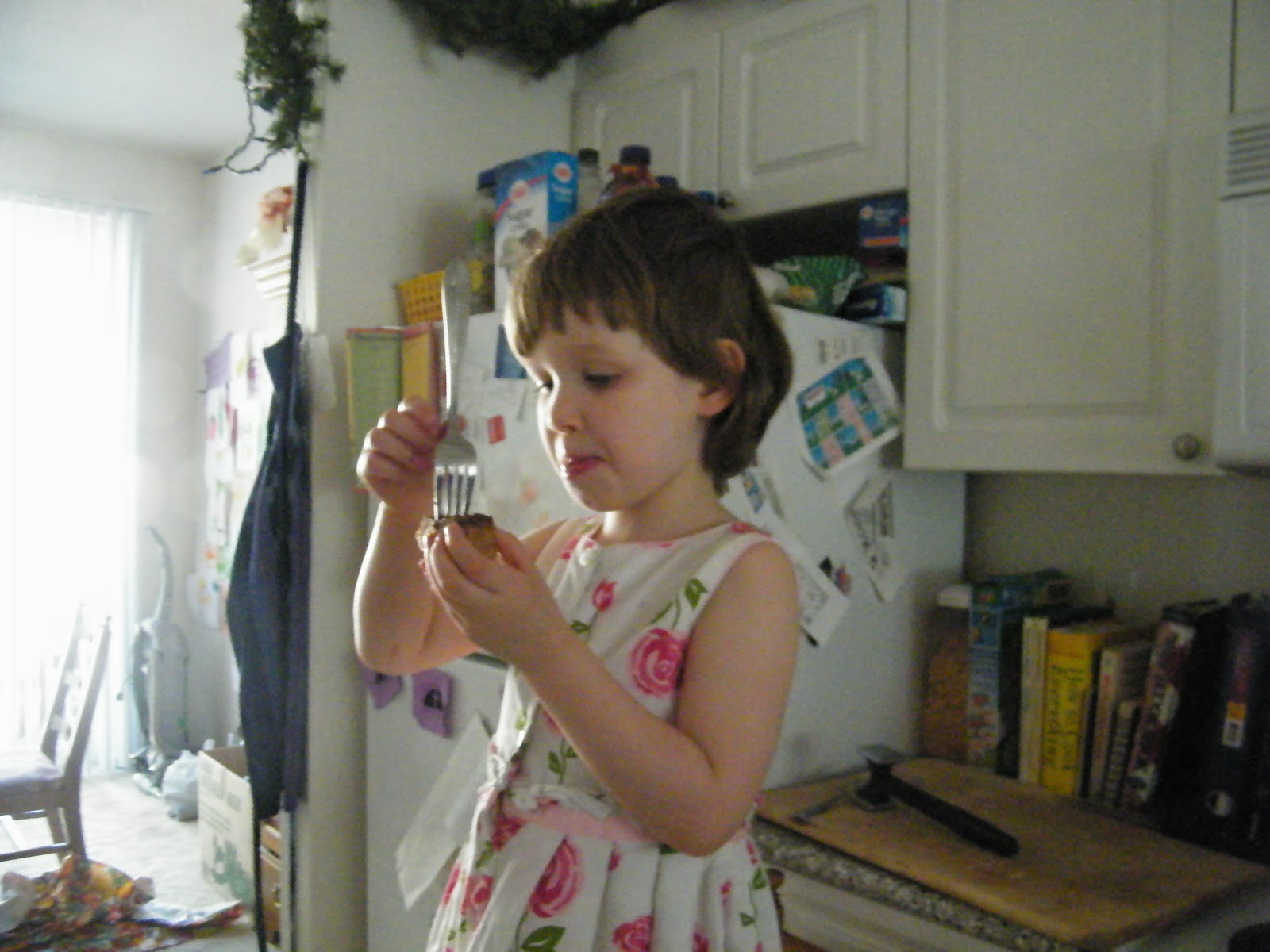
So we "baked" up a bunch of regular rice krispie treats, frosted them half with candy coating and half with frosting, and took them around to the relatives yesterday.  The concensus is that either is good, but the candy coating would probably be better in terms of thickness and richness.  I have been overruled, but it will probably be easier that way.  The white chocolate was by far the favorite (as well as being the most bridal), so we might do both cakes in white. 


You'd think we'd be sick of rice krispies by now, but we're still going strong.  The frosting is getting to be a little much though. 

Monday, July 2, 2012

More "pleasant things"

I meant to post these pictures a week ago, but somehow, it always takes longer to recover from a vacation than it does to go on one.  For now, I'll just let you look at the pictures, but it was a harrowing week. 

Perhaps harrowing week is a bit of a exagerration.  Still, it does not behoove one to camp in Oregon in June.  Oh sure, the flowers are blooming, the strawberries are ripe and the raspberries are ripening, the grass is still green, and the clouds are picturesque.  But all of that will be spoiled by the fact that it's still raining.  Summer doesn't come to Northwest Oregon (or anywhere north of it) until July.  That's convenient for the Independence Day travel, but it left us out in the cold. 

We had decided to grab one of Seth's five day weekends to have a little family getaway before the company sends him back to the Netherlands for three months, so we packed up all our rarely used camping equipment and headed up to Silver Falls State Parks, one of the most beautiful natural places on the planet (not that I'm biased or anything). 
Silver Creek, Silver Falls State Park
 In the 1800s, Silver Falls was a logging town in the foothills of the Cascades, logging being the principle industry in those parts at that time.  After logging died down, it turned to tourism.  A big portion was set aside as a state park in the early 1930s and done up in style by Roosevelt and the New Deal.  The park consists of a lodge, a conference center, a camp ground and horse camp, and ten beautiful waterfalls. 
The South Falls
The Willamette Valley, as seen from the Park Gate
We had a wonderful "weekend" planned.  We were going to hike the falls and relax by the campfire.  We even brought our swimsuits, though we weren't quite naive enough to expect that the mountain water would be warm enough for a swim.  We just wanted to be prepared.  We invited all the inlaws up for  a brat roast on Tuesday night, and we were looking forward to a lot of fun.  But Nature had other plans.  You see those clouds?  They are sitting directly over the park. (The sunshine is on the other side of the valley.) They sat over the park for all of Monday and Tuesday until after dinner when the stars were coming out.  And they dumped buckets, buildings, resevoirs of rain on us. 
We set up our tent and rigged up a tarp in the rain, but the trees were too far apart to support the tarp conveniently.  We didn't have anything to prop up the tarp in the middle, so Seth ran down to the local hardware store to find some wood, while the Boo and I tried to put the camp in order.  Notice what's holding our tarp up in the meantime. 
Our first tarp pole, est. height 4'
  
We got a brief break in the clouds, just long enough to remind us why we were out there, and Seth took us on a long walk to nowhere (Sorry, Love, but you did.).  He wanted to take us to see another entrance to the  park, and he kept saying, "It's just around the next curve."  It was not around the next curve or the curve after that or that or that.  You get the picture.  Still, it was beautiful and invigorating. 
The road to Nowhere, i.e. the park entrance.  This road does actually connect several towns with the Park, but it isn't very busy. 

Walking to Nowhere
Seth and the Boogaloo, halfway to nowhere
Getting tired of walking to Nowhere. 
Then the rain came back, so we spent a lot of the first evening cuddling in the tent.  Boo curled up in her sleeping bag with Curious George and ignored the outside for a while.  The more snuggling she gets the better.  She even woke us up the next morning with "I would like a snuggle please." 
Boogaloo buried in blankets and sleeping bags
The Boo, not being fully potty trained, soaked through her only two pairs of long pants in the first evening.  I rinsed them out in the hope that they would dry by the following day, but it rained all night.  We ended up drying them in the Jeep. 
Our impromptu dryer
Not to mention, it was cold.  When the rain was falling or threatening to fall, there were times when I could see my breath.  I hadn't brought a coat, just Seth's Navy sweatshirt.  For a whole day, the Boo had no dry long pants.  We shivered and chattered and snuggled and laughed at ourselves and made it until Tuesday night, but it's fair to say that we were pretty miserable under our gung-ho faces.  Boo spent a lot of time in the tent.  Seth and I spent a lot of time wondering whether we should pack it up.  But, doggonnit, we've only been on six camping trips since we were married, and only two of them had lasted longer than one night.  We decided to stick it out. 

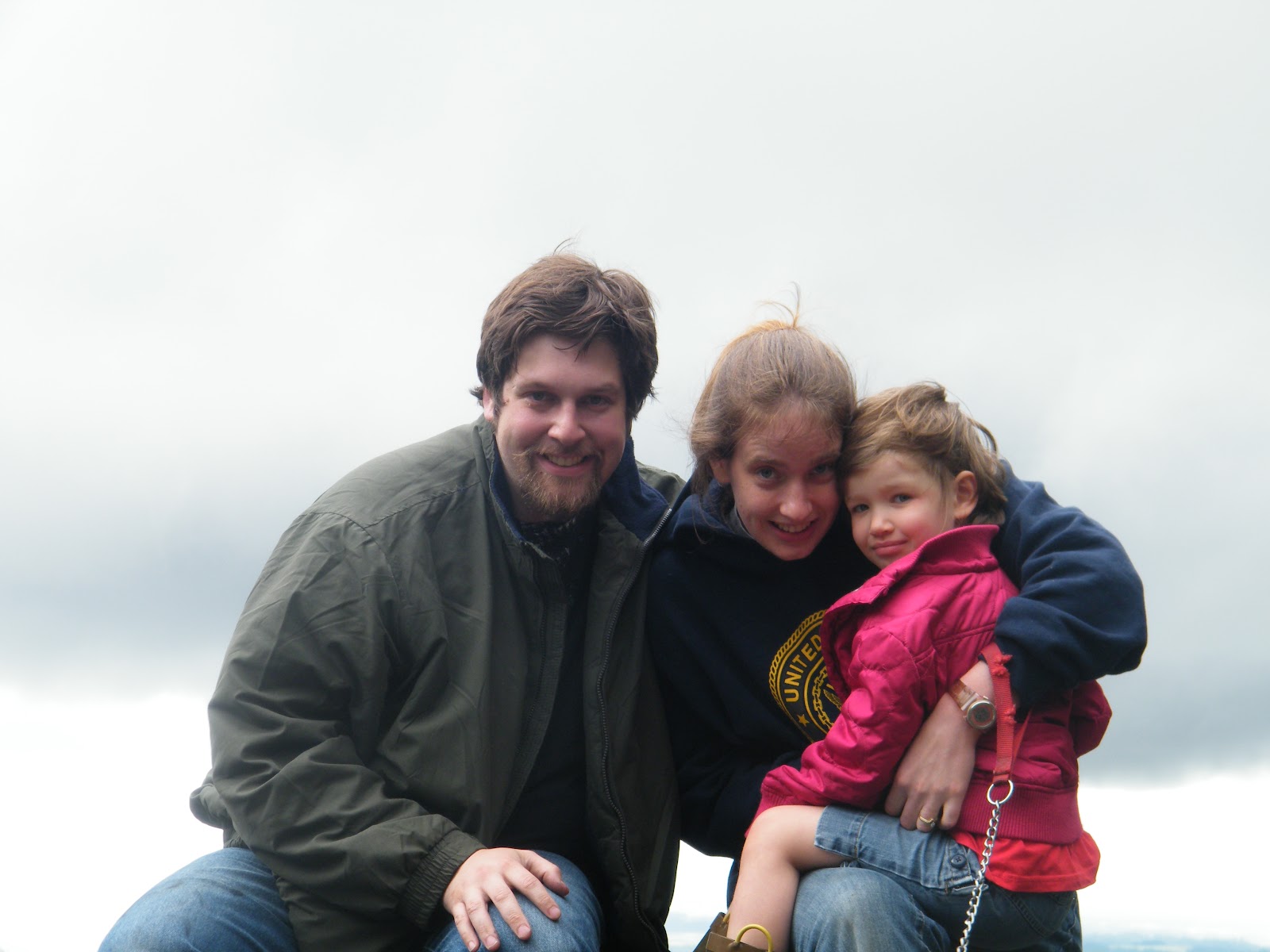
A portrait of family togetherness
And then the sun came out again.  Pake and Beppe came up to have dinner with us (Mom and Dad A took a look at the clouds and decided that we had already headed for home.  There's no cell phone reception up there, so we couldn't call and tell them to come anyway.)  We went for a lovely walk above the South Falls.  We grilled brats over the fire and fed Pake and Beppe their first smores. 

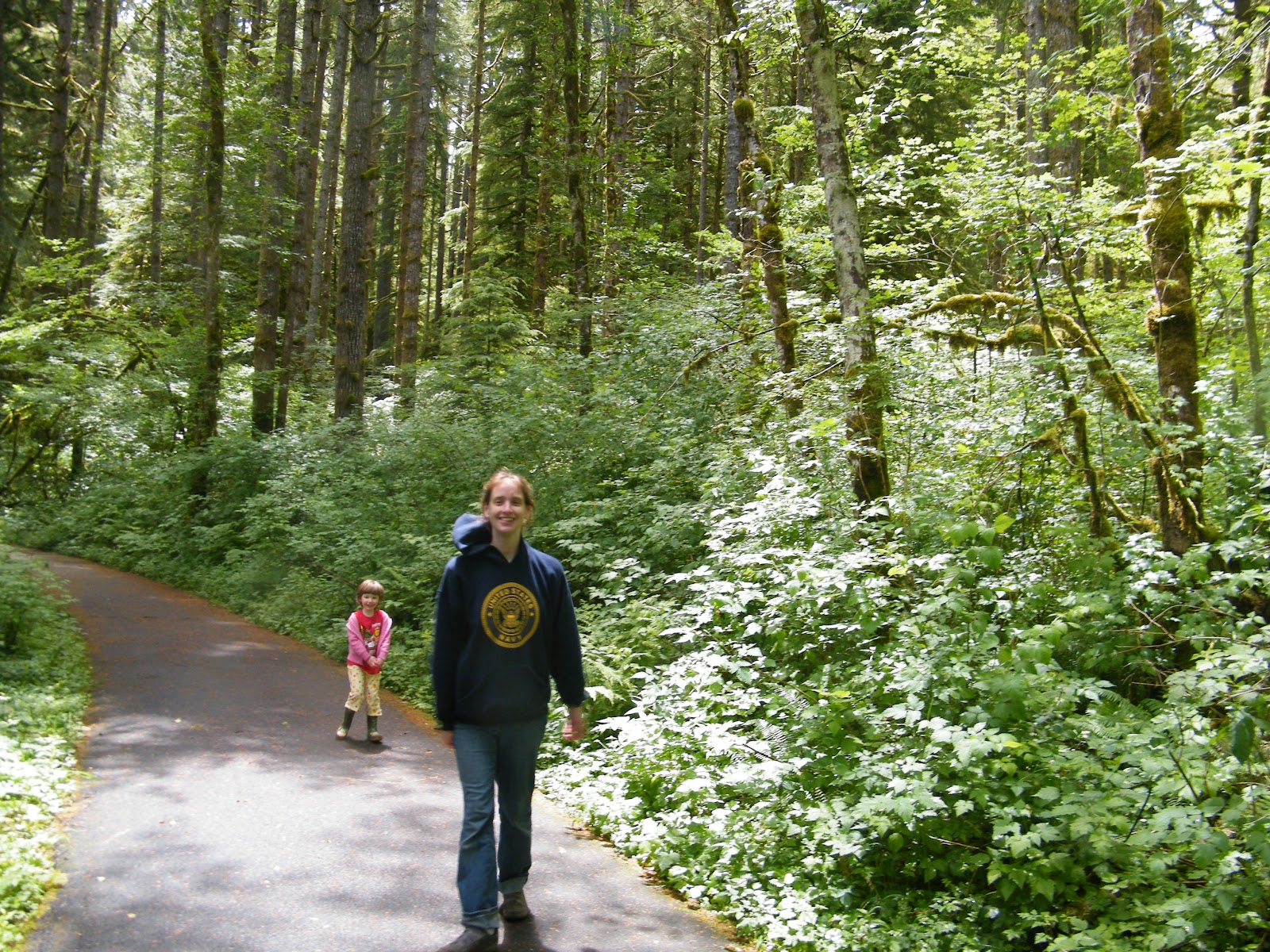
Walking to South Falls in the blessed sunshine
Pake and Beppe in the Lodge


Salmon Berries, just coming ripe
Boogaloo teaches Max about the river

 Sometime during the night the stars came out, and the next morning the sun was shining like it had never seen a cloud.  We ate breakfast and packed up in the midst of glorious sunshine and singing birds.  If Seth hadn't been expected back at work on Thursday, we would have stayed. 
Above Winter Falls, Wednesday morning
Trying to find Mt. Hood from the car window

Still, is it any wonder we were tired? 
A worn out party in the backseat

Wednesday, June 20, 2012

The perils of researching these things

I've been doing some pondering on Autistic Spectrum Disorder (ASD) since our trip to the Educational Service District (ESD) last month.  It turns out we had Boogaloo evaluated one week before the ESD went on summer break, so they won't be able to tell us anything more until the middle July.  In the meantime, I saw a little book entitled In the Syndrome Mix by Martin L. Kutschler (2005.) on the new books shelf of my church library and decided its presence there was providential.  Rather than spend half the summer biting my nails, I decided to do a little research on my own. 
According to Kutschler, disorders on the Autistic Spectrum are characterized by a lack of "theory of mind." Theory of mind means that a person can recognize the mind in another person with all the  possible differences that that mind might encompass. In other words, a person with ASD just can't tell what another person is thinking or feeling.  The programming to recognize and decipher social behaviors in the social context isn't in the computer.  People with certain ASDs may be very intelligent and speak very articulately, but they won't know how to interpret the situation in front of them.  As a result, they can't share experiences with people.  Even the most adapted people with an ASD may seem rude, inattentive, or odd to people who inherently understand social interaction. 

That's an intimidating prospect.  It's made even more intimidating by the feeling that I can understand that a little bit. 

 If my source is correct, the Boo most likely does not have Autistic Disorder (its proper name, rather than Autism) or Asperger's Syndrome, the two most recognized disorders on the Autistic Spectrum.  These two disorders are characterized by a lack of interest in interacting with other people, and the Boo loves to interact with other people.  She'll go up to any child on the playground and try to play with him or her.  Neither does she have Rett's disorder or childhood disintegrative disorder, which are ASDs that can be firmly diagnosed because they involve reaching a certain point in development and then going backwards.  So that leaves a list of disorders that don't actually have official names yet, and in that list I find two that I think are plausible. 

Semantic-pragmatic language disorders (SPLD) involve difficulty and delay with the use of language and how it relates to people and things, and I thought this was a pretty good fit. Apparently kids with SPLD are very good babies, but their language comes slowly and in pieces. They have difficulty with give and take in conversation and they will repeat things that they don't understand. They have trouble reading what's socially acceptable, but they aren't inclined to act out or break rules. They also have trouble with symbolic play (imagination). If the Boo didn't put her babies to bed before naptime, I would say SPLD fit her to a T, but she is so imaginative, and that is such an important trait of the disorder that I think this can't be what she has.

Non-Verbal Learning Disabilities (NVLD) might be a possibility.  They involve trouble bringing the pieces together to make a whole.  People with NVLD have linguistic, spatial or motor problems. I don't see any problems in Boo's motor skills, but spatially, I see a lot of problems.  She doesn't get spatial directions, and she runs into familiar objects a lot.  Socially, she is gradually picking up on the notion of give-and-take conversation,but I am constantly thinking, "Kiddo, you should have developed this already." These are all traits of NVLD, as are rote speech, pedantic speech patterns, and clumsy monologues.  A child with NVLD likely would not answer questions or pick up on the fact that the last sentence she heard was a question.  That's my Boo all over. 

Finding the Boo's attributes under the less pervasive disorders made me feel good.  It intimates less work for me, for one thing, and less heartache for her.  The brain can make databases for semantic and pragmatic speech and social activities. Socializing may never come naturally to her, but she'll be able to create a manual override system.  Sometimes, when I analyze my own thought patterns, I think that's what I've done to get along.  It was disturbing, really, to find so many of my own attributes in this chapter:
  • tendency to monologue  -- check
  • can't catch the tone of a joke or conversation -- check
  • prefers reading and writing to playing with peers -- check, and double check as a child
  • prefers working with objects/projects to working with people -- check
  • is often thought of as rude or awkward -- actually, I wish people would have brought this up to me more often in an analyitical sort of way
  • finds that social interraction makes her anxious -- check, like heart-skip-a-beat anxious
  • depends heavily on routines and familiar spaces -- less so now, but check
I brought this feeling up to Seth last night because it really depressed me.  Just by indentifying these attributes with mine, I felt diminished, like I'd been socked in the solar plexus and flattened out to a diagram.  I also felt a little guilty.  What if the majority of Boo's problems come from me?   Seth laughed and said he thought my real disorder is hypochondria.  He may have a point.  But where does one draw the line?  That's an important question.  When does social awkwardness become a disorder?  The textbook answer is when the problem debilitates you.  Yes, but in what sense?   How can one tell the difference between competent introversion and high functioning ASD?  Does it all boil down to the question of happiness?  I don't know.  I guess those are questions for the experts. 

Wednesday, June 6, 2012

"Extremely Loud and Incredibly Close": review and commentary

My husband and I watched Extremely Loud and Incredibly Close on Monday night.  Seth has been wanting to see it for a while.  I'd seen the advertisements but I hadn't paid enough attention to even read the synopsis, so I didn't know what it was about.  My mistake.  This is a movie that is worth seeing in every way. 
Not only is it about a poignant story that every American over the age of twenty should be able to appreciate in some way, but it's also beautiful, realistic, and personal.  Thomas Horn, who plays the main character and narrative voice, is completely engrossing as a boy with indeterminate Asperger's  Syndrome who is trying to make sense of the death of his father, the only person who really understood him, in the Twin Towers on 9/11.  He's supported by an array of award-winning actors and actresses and led by a bittersweet script that keeps him personal  even when the obsessive and anti-social parts of his disorder are abrasive and hard to deal with.  The photography captures the dirt and hustle of everyday, industrial New York City and sometimes manages to make it beautiful, and the story has hope, even though we know from the beginning that his quest is pretty hopeless.    

I knew the movie was going to be gut-wrenching when the first shot was a picture of a man's dress shoe, upside down and apparently falling through a clear blue sky.  The only sound was the deafening whistling of the wind.  It was like a kick in the gut.  We all saw the people jumping out of the burning offices, but how many of us thought about what it would feel to freefall to the earth?  What would it have been like in those moments before death?  Apparently the author or the director had given it some thought.   Then twenty minutes in, I realized that Seth was sniffing, and I was sniffing.  Never outright tears, but lots of sniffing, and the sniffling continued through the whole movie. 

Of course, watching the movie was emotional.  We might not have been at the scene of 9/11 or lost anyone to it, but we experienced it.  It felt like our guts were ripped out that morning as we watched the towers fall and the last survivors stagger out in a cloud of dust.  We watched for weeks, praying for yet another survivor to be uncovered in the rubble.  We cheered the stories of heroism with tears in our eyes and wept openly for the families bereaved.  9/11 was one of the touchstones of our generation, like watching the Berlin Wall come down (I was 9 when that happened.  I got to stay up late to watch.), only in the opposite way.   The fall of the Berlin Wall put us on top of the world.  9/11 brought us back down again.

When 9/11 happened, I was in a van, driving to a ghost town in the middle of the Iowa cornfields.  My writing 201 class was focusing on setting, I think, and Dr. Schaap always took his 201 classes out to this place.  We listened to the radio reports on the way out and on the way back, and it was like time and space had been transcended because we were so close to what was happening in New York City.  In between we sat among the tombstones of people who had died 150 years ago, most taken too soon, at least by our standards.  It was a kind of anchor, I suppose, to remember that we all die, and that death is often a tragedy.  Even 150 years couldn't really make sense of it, but it could put it in context. 

I think what Extremely Loud and Incredibly Close does is add some context to the loss of 9/11, to remind us that fire and hatred aren't the only way we can lose someone, to show us the basic human relationships that were interrupted and the relationships that were reforged.   It wasn't entirely enjoyable, but it was a good movie.   

Wednesday, May 30, 2012

Completing the Circle.

When I was in college I wrote an essay called "Paper Peelings: Reflections on Writing with a Computer." It was kind of sappy, though I think most of it was good prose.   It sure put my professor in ecstacy. (He was something of a Luddite.)  In it, I compared the process of composition to allowing thoughts to trickle together into a roaring stream.  Writing on paper was to writing on a computer as walking in a woods is to sitting in a plastic storage container.  Still, when the paper says, "I have the patience of trees that only grow because the sun is above them.  I have the patience of water that travels as slowly as osmosis," that's a little corny.  Cue the violins. 
 At the time, I had problems with composing on a computer.  "I write all of my papers by hand.  I like the permanence of ink and paper, the patience of faint blue lines," I said.  And the thing is, I did. I took issue with electronic efficiency.   I hated writing on a computer.  Writing on a computer felt slapdash and tossed off.  "Sitting in front of a screen, staring at all the space that I can fill, looking at all the words that I can move, delete, copy, and paste makes my mind as blank as the screen.  There's just something about the sterile gray (gosh, that's dated) plastic square holding the blank, pasty-white (likewise dated) screen with all my thoughts that dries up the well inside me."

Then I got out of college, and I found that it was possible, even easy,  to let my thoughts go crazy while I was staring at a screen.  As my fingers got faster (after all, if you can't type, a computer doesn't do you any good), I really started to like writing on a computer.  I transferred all my stories to floppy disk (that was a mistake!) and sat happily in front of the blank screen of my husband's cast-off laptop whiling away many hours of deployments and duty nights. 

 I'm not sure what I wrote -- nothing of consequence, I'm sure -- but the fact was, the sterile computer screen was no longer my creative nemisis.   Maybe it helped that computers got smaller, that screens became blue instead of gray, and  that I got to personalize the background.  There's a world of difference between an institutionalized computer and one's own.  At least there was when I was in college.  Now we can store our own home base somewhere in the cloud and log into it from any computer.  I haven't gotten that far yet.  But I do have a blog (obviously), and I no longer dreaded the sight of a blank, glowing page. 

The thing is, since I started working online, I've felt a regression coming on.  All of these creative thoughts are building up inside of me (and my therapist assures me that that's a bad thing),  but after spending two hours a day slogging at other people's papers, correcting spelling errors, suggesting new fonts, putting in headings, and constantly rewriting absolutely abysmal sentence structures, all within prescribed time limits, I can't equate computers with creativity anymore. 

Trying to write my own thoughts on a computer after two hours of all that is like standing up to make a speech and suddenly finding myself deprived of words.  I have all these things that I want to say and none of them come out.  Instead of trickling out into their rightful pool, they build up inside my head, gradually increasing pressure, which in turn increases heat, which means that there likely is metaphysical steam blowing out my ears.  I think I can hear myself whistling. 

So I've picked up my notebooks again.  Notebooks are patient.  I can leave them lying around unplugged for days, and they'll still work when I pick them up (provided I can find a pen).  I can use them before bedtime without unduly stimulating my brain with blue light radiation.  And there's something therapeutic about the process of putting ink on paper.  I can feel the tension drain out of my shoulders and through my fingertips as the ball of the pen rolls steadily along the faint blue line provided for me, and the only reference for my thoughts is my thoughts.  For all the adaptations I've made to a computerized lifestyle, computers still don't do that for me.